Search A n R

Showing posts with label Gravy Sabzi. Show all posts

Saturday, August 13, 2016

Baingan Ka Bartha - Smoked Brinjal and capsicum in tomato gravy

A long time since I wrote down some traditional, go to recipes. I learnt this while in school from my mom. She is very fond of roasted brinjal recipes. There is another one apart from Baigan ka bartha. The other one is made with fresh ground spices and curd. The king of the vegetables is a favorite in the Andhra (Telugu) cuisine and is almost a must have in wedding and festive menus. Most friends of mine die hard fans of brinjal and a stuffed brinjal recipe being one of the most sought after (Gutthi vankaya).

The original roasted brinjal recipe is originally from middle eastern/Persian kitchens and is called Baba Ghanoush, Indian versions use a few more spices and different oils (original Persian recipe uses olive oil). My recipe is a little different from the conventional baingan (brinjal) ka Bartha as i add the smoked/roasted capsicum for a very unique twist to the dish

Allergy: Soy free, dairy free, vegan, low spice and low fat
You need:
(serves 4 sumptiously)

Dish type: Sabzi/gravy/soup
Origin: Middle east 
Prep time: 20 minutes
Cooking time: 15-20 minutes
Author: Sudha

Main Ingredients
Brinjal (big variety)- 1/2 kg 
Capsicum - 2  (large ones)
tomatoes - 4 (large ones)
onion- 2 large
ginger - 1 inch piece
garlic - 3 cloves

Spices:
Turmeric - 1/2 tsp
Sambhar / Khuzhambhu powder - 2 tsp
garam masala - 1/4 tsp
salt (to taste)
Ghoda masala - 1/4 tsp (optional)
chilli powder -1/2 tsp (optional) (i skipped it )
Water - 1/4 cup 

Tempering
cumin seeds - 1/2 tsp
bay leaf - 1
red chilli - 1 
oil - 2 tsp 

Procedure

1- Slit the brinjal lightly on the skin and rub a little olive oil on the brinjal and the capsicum. It helps in roasting better

2- Fire roast them


3- Crush Ginger and garlic and chop tomatoes


4- Peel (lightly) and Chop the roasted brinjal and capsicum, and chop onions as well


5- Pour oil in the pan and add tempering ingredients (cumin, red chilli, bay leaf)
6- Add in onions, ginger garlic paste and saute on low flame until the onion turns translucent and browns a little
7- add turmeric powder, sambhar /kuxhambhu powder, ghoda masala and saute for a minute
8 - add tomatoes and pour a little water and saute until the gravy is well done. 
9- add the capsicuma and brinjal and saute for another two to three minutes on medium flame. pour the remaining water or as needed and add salt and cook until the ingredients come together 


All done


Works very well with breads/ roit / rice. I love them with cooked millets :)


Friday, May 27, 2016

Pumpkin and Black chana (Black chickpeas) in coconut and kokam gravy

Moving to the current city helped me understand the local cuisine and the other regional cuisines within the state. Konkan being one of them. A distinct feature of maharastrian/konkani (a few kannada) kitchens is the use extensive use of kokam for the tangy flavour. (Tamarind does this job in Tamil, telugu and kannada recipes)

Kokam lends a beautiful pink-purple colour to the dish. And when mixed with coconut milk or paste the dish looks an exotic pink. :)

This recipe is something i came up with just because I wanted to use kokam. Now for some pics...and then the recipe :)


Allergy information: Vegan, Soy free, dairy free, nut free, low fat and mild spice
Author/recipe owner: sudha What you need: (serves 2-4 people)
Main
Pumpkin (peeled and diced) - 1 cup
Black chickpeas/ kala chana - 3/4 cup
Salt - to taste
turmeric powder - pinch

Gravy
Fresh Coconut - grated - 1/2 cup
Kokam - 3 rinds or florets (soaked in just enough water)
green chilli -1/2 (optional)
cumin seeds - 1 1/2 tsp

Tempering
Coconut oil - 1 tsp
mustard seeds - 1/2 tsp
cumin - 1/4 tsp
red chilli - 1
curry leaves - 4
Asafoetida- 1 pinch

Process:
1-Soak 3/4 cup Chana/chickpeas overnight and pressure cook with salt
2- Boil the pumpkin with just enough water, a pinch of salt and turmeric powder (Salt optional as we add sufficient amount of salt in the chickpeas.)
3-Grind ingredients for the gravy/coconut masala
4- Separate the cooked chana from the water it was cooked in (you could use it but it lends a dark colour to the gravy)
5- when the pumpkin is half done, add the cooked chana and saute for a minute.
6- Add the coconut masala and simmer for five minutes or until the gravy looks evenly looks.
7- Temper with mustard, cumin, asafoetida, curry leaves and red chilli

serve!

Works well with roti and rice

Green /Raw Papaya and chickpeas kabuli chana) in a mixed spice and tomato gravy

A pleasant person with a very charming personality came home for dinner last night. Had to make something yummy for her, Honestly, its very easy to cook for someone who appreciates variety and loves to experiment with food.

Made this gravy dish apart from the ever green mirchi ka saalan a carrot stir fry (recipe coming soon!) and my famous beetroot dhum / dum biryani :). 


The dish: 
Green papaya has been combined with pre soaked and pressure cooked chick peas to give a wonderful blend of juicy vegetable and a gluten free protein.

Serving suggestions: Can be served as is as a soup with a sour dough bread or simple roti/ phulka

Allergy info : Vegan, gluten free, Soy Free, mild spice, Low fat

Ingredients (serves 4 conservative) / 2 sumptuous :)

star ingredients
Green papaya - peeled and cubed - 1 1/2 cup
Chick peas (soaked over night and pressure cooked for two whistles) - 1 cup

boosters
tomatoes - 3 small
Onion - 1 large
Green chillies -2
red chilli -1

Flavour and spice

coriander seeds - 1 tsp
jeera - 1/2 tsp
Dry coconut / copra (grated) 3 tbsp
Khus Khus / poppy seeds - 1 tbsp
Til / ellu / Sesame seeds - 1 tbsp
elaichi  1
clove 1
cinnamon 1 cm strip
ginger - 1 cm
garlic 2 cloves
tamarind or kokam (pulp)1 tbsp
turmeric- 1/4 tsp
salt to taste

Water - to cook the papaya and chickpeas. and to grind the masala (2 cups)

garnish and temper
Curry leaves one string or 8-10 leaves
Coriander leaves  chopped 2 tbsp
Til or peanut oil - 1 tsp 
Mustard seeds  1/2 tsp
jeera - 1/4 tsp
bay leaf -1


Process: 

1 Boil the cubed papaya fro ten minutes or if its fresh, pressure cook it for a whistle
2 Pressure cook pre soaked chick peas with some salt and a little turmeric powder
3 Dry roast coriander seeds, jeera and other spices (Exclude turmeric, khus khus and tamarind pulp)
4 Set aside on a plate to cool
5 Soak khus khus in 3 tbsp of water
6 Grind the khus khus and then add the dry roasted spice mix and grind into a smooth paste
7 Transfer the mixture into a bowl and then in the same mixer jar, grind tomatoes, onion and chillies
8 Take a deep pan and add oil and when the oil is warm enough, add mustard seeds, bay leaf curry leaves and jeera
9 Once the tempering is fragrant, add the tomato onion, chilli puree and cook until its a half done,
10 Add the ground spice mix and add turmeric and tamarind pulp
11- cover and cook for five minutes on medium heat
12add the cooked papaya and chick peas,
13 add salt and half of the coriander leaves and cook well until done (chick peas and papaya should be sturdy and not mushy)

transfer into a bowl and garnish with the remaining coriander leaves

Done!!!!!


Do try my green papaya thoran recipe>> here 

Tuesday, January 31, 2012

Paarikkai / Pavvakka ulli theeyal ~ Tribute to my Palakkad roots

I generally dont click pics of regular/traditional dishes made at home. Wanted to change that this year and start documenting usual, day to day recipes as well (thanks to that special someone who pestered me to do so :)) Ulli (onion) and Parikkai (Bitter gourd) theeyal is a definite favourite of mine. (I am known for my love for bitter gourd :P). And as usual, this is a low fat recipe.

I decided to post this recipe to join a Kerala Kitchen event at Palakkad Chamayal :) This being my first such participation in the food blogging circle. I hope to have fun!!

Etymology:
Theeyal, a must have in most onam lunches (sadhya) literally means - burnt dish. This name is derived from the colour of the dish as we use well roasted coconut and tamarind.


This is exactly how its made in our kitchen.
You need: Serves 2-3
Water - 2 1/2 to 3 cups
Bitter gourd - 2-3 small /medium (de-seeded and diced)
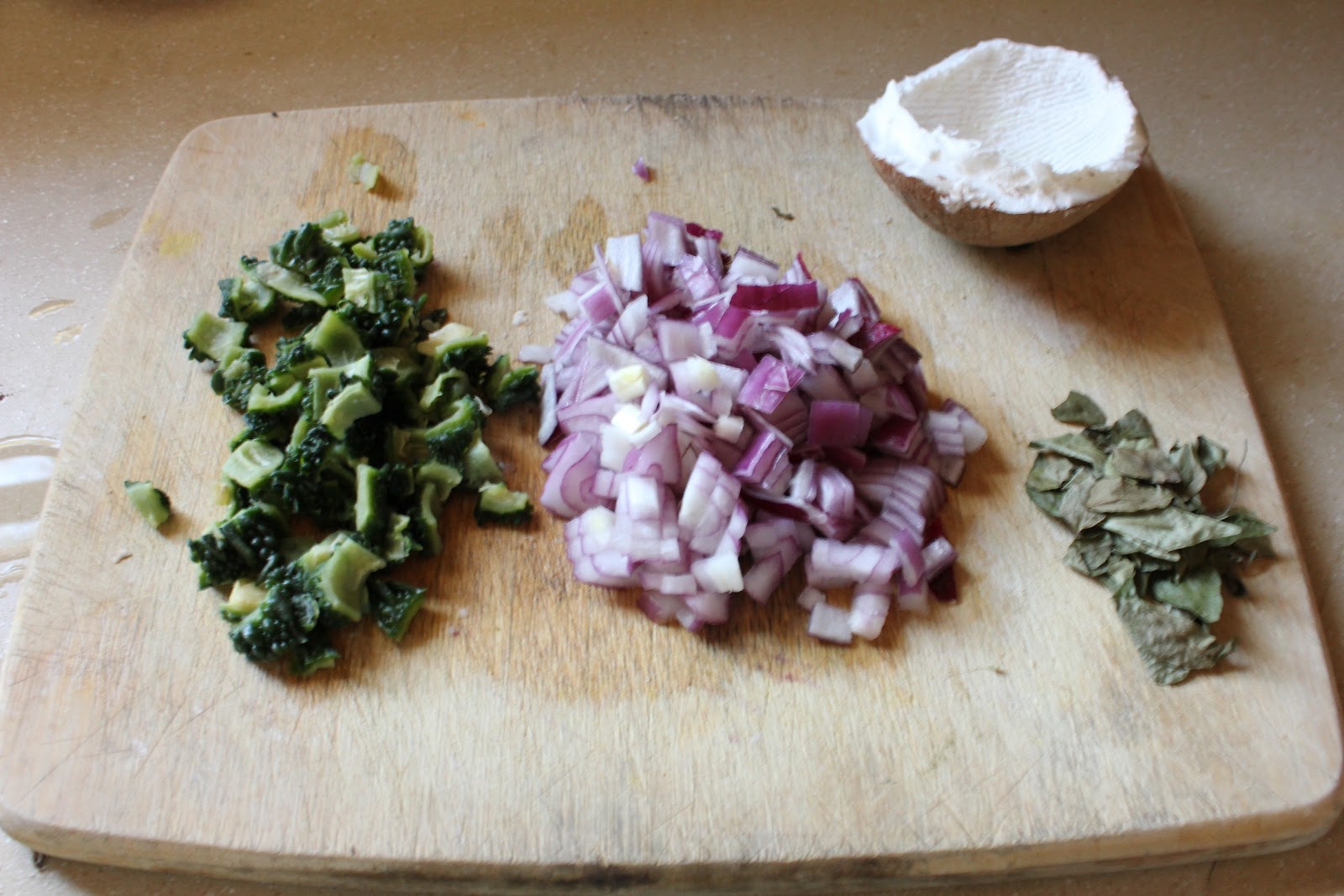
Onion - 1 (diced)
coconut - shredded- 1/4 cup
curry leaves - 3 tsps (I use dried leaves)
Coconut (or til/ sunflower / olive) oil - 1 tsp

Flavoring / spices
Tamarind - two strips or a size of small lime / 3 tsps (if using paste)
Red chillies- 3
Turmeric powder - 2 pinches
Jeera / cumin- 1/2 tsp
Methi /fenugreek seeds - 1/2 or 1/4 tsp
pepper corns - 1/4 tsp
coriander seeds - 2 1/2 tbsp
Jaggery (optional) - 1 tsp


Use (Set aside) for Tempering
oil, mustard seeds (1/4tsp), a little cumin seeds, curry leaves, fenugreek seeds(optional), one red chilli

Procedure:
  • Soak Tamarind in a cup of water and microwave it for two minutes. 
  • Let it cool , add some water, mash the pulp to prepare two cups of tamarind water
  • Wash bitter gourd thoroughly and chop into small pieces; Soak them in salt water for ten minutes 
  • Chop onions and grate/shred coconut
  • In a pan, Dry roast coriander seeds, cumin, peppercorns, two red chillies, curry leaves, cumin seeds,  (with a little set aside for tempering) and coconut. you could add 1 tsp of onions (optional) 
  • Transfer well roasted ingredients onto a plate to cool
  • Grind the roasted ingredients into a smooth paste
  • In the same pan, pour a 1 tsp coconut or any oil of your choice
  • (you can avoid using oil because roasting of coconut leaves a thin film of oil in the pan)
  • Put in mustard seeds, cumin seeds, red chilli, curry leaves and saute for a minute
  • Add onions and saute for another minute before adding thoroughly washed bitter gourd 
  • Stir well and cover for a minute and pour in the tamarind water
  • Add salt, turmeric powder, and fine fine ground theeyal paste
  • cook until vegetables are all done and you get the yummy aroma of cooked theeyal


Serve with steamed rice, cracked wheat or roti/ bread of your choice


And off I go to join the fun at Palakkad Chamayal :)

Saturday, December 18, 2010

Raagi Lauki Kofta - Low fat and healthy!

A small twist to usual lauki kofta. I prefer using raagi (millet) flour instead of chickpea flour (besan). Baking the rolls instead of frying them is the low fat twist to an otherwise oil consuming recipe. to be honest, no sabzi is special in my kitchen, that is because, our menu looks like a buffet list everyday. (I am sure hubby would appreciate this dish more if i gave him a rasam, saambhaar or dal n curry routine everyday!)

This recipe packs wholesome goodness of bottle gourd and millet and is a crowd pleaser.

How about a picture tour !
Lauki and raagi mixed with spices (salt, turmeric powder, ginger, chillies and garam masala powder) - rolled and ready for baking.


Drizzle some oil (olive or any other cooking oil) and bake at 375 for 30 minutes (use the middle rack and roll them over after 15 minutes. The final five minutes, put the tray on the top rack for a crisp exterior)

let them cool
( raagi gives the kofta a deep choclate colour and a faint sweet flavour - so you may want to tone up the spice levels)


Work on the gravy - (onion, tomato, poppy seeds, dry coconut, almonds. peanuts, ginger, garlic, cloves, cardamom, coriander seeds, cumin and cinammon stick (tiny 1 cm piece)- ground together) and sauted in a tsp of oil and a bay leaf


drop in the kofta when gravy is well done. and pour in a tbsp of curd /cream (optional). Simmer for a minute and you are done.


serve with rice or parata. Works with a whole wheat bread slice as well!

PS:
you may fry the kofta, i bake them for a low fat version
raagi makes the kofta a little dense, adding 1/2 tsp of baking or cooking soda (for 1 1/2 cup of raagi) may help ( i dont add it though)
adding a spoon of sugar to the gravy seems to appeal to kids. (gives it a ketchuppy flavour i guess)


Wednesday, June 23, 2010

Dum aaloo

I made dum aaloo sometime back and instead of posting my version, I wanted my friend Pooja to submit her recipe for a guest post. She obliged and sent me a picture and the recipe.


Dum Aloo recipe

18-20 small-sized potatoes
Oil to deep fry
½ tspn red chili powder
2 cups of yogurt
1 tspn coriander powder
1 tspn of dry ginger powder
1 tblspn of fennel powder
5-6 cloves
Salt to taste
tspn of roasted cumin powder
tspn of garam masala powder


Recipe
  • Boil the potatoes ( pressure cook -1 whistle )
  • Peel and prick the  boiled potatoes all over with the help of a fork. Heat oil in a kadai and fry the potatoes on medium flame till golden brown.
  • Whisk the yogurt with red chill powder ,salt, coriander powder, garam masala powder , dry ginger powder and fennel powder.
  • Heat 2-3 tbspn oil in a pan.
  • Add clove , half a cup of water and bring to a boil
  • Stir in the yogurt mixture and bring it to a boil
  • Add fried potatoes and cook till the potatoes absorb all the gravy and oil floats on top
  • Garnished with freshly roasted cumin powder(optional).

Serve with roti, parata or a bowl of steamed rice/jeera rice

Monday, March 22, 2010

Lettuce and Matki sprouts Dal /Soup

Greens are great for your digestive track as they bring in fiber into your diet. A good digestive system ensures smooth running of your other systems and that mean over all health! Salad, soups and grilled forms of leafy vegetables should be made a part of your everyday meal. However, it is important to check for allergy information before you choose your greens. For example, people with Thyroid malfunction are asked to minimize use of a few vegetables, such as cabbage, cauliflower, soyabeans or soya products (as these food varieties contain goitrogens and do not allow absorption of Iodine by the body.)

Lettuce is among the common greens used in salads. I recommend that you try at least one variety of lettuce in your diet if they are available in your local market. Here is a nice article on Lettuce varieties for you to know more about this leafy veggie. HERE . If you are bored of eating raw lettuce in your salads and sandwiches, this simple soup/dal recipe is a nice way to eat your lettuce. It is very easy to make and is great on a cold night.
leafy veggie - Red leaf Romaine lettuce
Moth dal (gujrati) or matki dal (Marathi) - Raw
Matki /moth dal (sprouts) and other lentil varieties feature prominently in Gujarati and Marathi cuisines
For this recipe:
Soak matki in water for at least 8 hours and drain it completely 
Tie it in a neat kitchen towel and leave it for a day for the matki to sprout
you could also use the soaked matki for this soup/dal 

All you need: serves 4
Matki sprouts - 1 1/2 cup (use 1 and  cup raw matki for 1 1/2 cups sprouts)
Romaine lettuce (a bunch) - 3 cups when chopped
Onion- (chopped) - 1/2 cup
spices: to grind
cumin seeds 1 tsp
Green chillies- 2
curry leaves - 5/6
mustard seeds (black) - 1 tsp
ginger - 1" piece- grated
garlic- 1 clove (optional)

Spices
turmeric powder - a pinch
kuzhambu powder - 2 tsps
Indian Garam masala - 1/2 tsp
Salt
Asafoetida -  a pinch
Bay leaf - 1 (fresh or dry)
oil - 1 tsp

Clove - 1
cilantro/coriander leaves for garnish

Method
  • Pressure cook matki / moth sprouts (a single whistle)
  • Grind mustard seeds, cumin, chillies, garlic, ginger, curry leaves and  half the quantity of onions into a smooth paste
  • In a kadai,  pour oil and put the clove and bay leaf and remaining onions and saute well
  • Add the chopped lettuce leaves and keep stirring until the lettuce is half done
  • Add the pressure cooked matki /moth sprouts and stir well
  • Pour the spice paste and salt, turmeric powder, asafoetida, kuzhambu powder and cook until done.
  • Add garam masala powder (optional) and simmer for another minute
  • Serve this soup with bread/roti or steamed rice


you could add some water while cooking to make the dish a little more soupy.


Trivia: ayurveda
Mustard and cumin paste helps in keeping your body warm in the winters
Asafoetida and garlic help in digesting the lentil better and reduces gas in your stomach
Lentils /whole dals (not kellogs lol...) are easy to cook and digest when they are soaked allowed to sprout

Thursday, March 18, 2010

Hyderabadi Mirchi Ka Saalan - An ode to Chillies

Coming from the city of Hyderabad, it is natural that I love hyderabadi food (vegetarian). I am sure most of us would have heard about the famous Hyderabadi Biryani. Infact,  biryani, mirchi ka saalan and bagaara baingan are a staple in most hyderabadi wedding menus and served along with rasam, saambaar, pappu and gongura pacchadi. (slurp!)

I was watching an episode of - The Best Thing I Ever Ate on the food network. I liked it when Ted Allen, an Emmy winning food writer, host and reviewer, mentioned Mirchi Ka Saalan as his favourite dish under Spicy category. And that reminded of this long pending draft and I sat down to finish the post. This is among several pending/scheduled posts for the blog. :).

Etymology and more...
As the name suggests, Mirchi Ka Saalan - translates to Chillies in a spicy gravy. This dish is truly an ode to the Chilli/pepper because, most recipes only use chillies as a spice and a flavouring agent. This dish has chillies as the main ingredient. Every authentic Hyderabadi restaurant serves Biryani with a bowl of Mirchi ka Saalan and Spiced raitha. Yummm!

Most Hyderabadi dishes are a nice blend of two very unique and wonderful cuisines - The Nawabi food/recipes adapted to the Andhra (local) ingredients. For example, among few other spices, addition of tamarind pulp, peanuts/groundnuts and red chillies to a typical nawabi masala gravy is the southern touch I am talking about. This blended cuisine is also called - Dakkani or Deccani khana.(derived from - Deccan plateau). Although Deccan plateau spans across south central India, Deccan food is more of a Hyderabadi/Nawabi speciality. (May be because Hyderabad was the capital city of the Hyderabad Sultanate and Qutub Shahi Dynasty)

Deccani food includes subtle variations from vidarbha and north eastern Karnatka (Bidar and Berar). Whatever the name, Hyderabadi food is simply wonderful. Also check out my adaption of locally available vegetables into Bagaara Baingan's gravy - Bagaara Celery and Pumpkin (mathan)

The recipe...
There could be small variations to this dish made in different kitchens. We generally use mirchi (the ones used for bhajji - Banana peppers) for this recipe. I used Serrano peppers. Any variety of Green chilli/pepper which could hold up in a gravy works well in this recipe. Types of chillies/peppers which could work for this recipe- Sweet Bell peppers (Capsicum), Poblano peppers.  My version of the Mirchi Ka Saalan requires very less oil, preferably olive oil.


You need: Serves 4

Banana pepper or Serrano peppers - 9-10

Spices for the gravy
Coriander seeds - 2-3 tsps
Cumin seeds- 1 tsp
Coconut - 4 tbsp (dry or fresh) (grated)
Tamarind (pulp or paste) - 2 tbsp
Ginger - 1 " piece
Garlic- 2 or 3 cloves
Red chillies - 2
Sesame seeds (til or ellu) - 1 tsp (optional)
Groundnuts (roasted) - 4 tbsp or a count of 15 - 20
cloves 2 or 3
cinnamon 1 cm strip
elaichi 1 (optional)
bay leaf 1
Curry leaves - 6 -8
Poppy seeds (Khus Khus) - 2 tsp
Onion (chopped) - 1/2 cup
Salt to taste
turmeric powder - 1 pinch
Asafoetida - 1 pinch
oil - 1 tsp

Cilantro /coriander leaves for garnish

Process
  • Slit open the chillies/peppers and scoop out the seeds and soak them in salted water (helps in reducing heat)
  • Soak Poppy seeds in just enough water and leave it for a while
  • Dry Roast coconut for half a minute or so and take care not to turn it brown. Transfer it to a plate and let it cool.
  • In the same Pan/kadai roast corainder seeds, cumin, split chickpeas / chana dal, red chillies and onion along with cloves, dalchini (cinnamon) and elaichi
  • Roast sesame seeds separately (they splatter so keep the flame low)
  • Fine grind the sesame seeds and then add the rest of the roasted spices, ginger, garlic, coconut, curry leaves, tamarind pulp and prepare a smooth paste.
  • Grind the soaked poppy seeds (separately) into a smooth paste (poppy seeds tend to remain coarse if ground along with other spices)
  • Drain the chillies (from the salted water) and use clean kitchen towel to pat them dry
  • Pour 1 tsp oil in a kadai/wok/pan and saute chillies
 Pour in the ground masala into the kadai
Add salt, turmeric powder and hing(asafoetida) and cook until the chillies look done and masala looses raw smell

Garnish with cilantro/corainder leaves and serve with Biryani /flavoured rice or simple steamed rice
Try this Hyderabadi classic and do let me know if you liked it...until next time take care!

Trivia:
  • Did you know that chilli/peppers used as flavouring agents and a spice, are basically classified as berries 
  • A simple ground rule to choosing chillies, the smaller the chilli, the hotter it is!
  • Here is a brief guide to choosing your chilli based on the intensity of heat: HERE - chillipeppermadness.
  • (Chillies is the spice and not the Chilli recipe famous in the Americas.) 

Wednesday, March 10, 2010

Undhiyu - A veggie delight from Gujarat


Hop into the Flavour Train with me. Let us take make a trip to a western state in India, Gujarat, and sample a Vegetable specialty -  Undhiyu. This dish is seasonal and is generally made in winters. This is because winters are the time of abundance in a normally arid Gujarat. It features in most festive menus and is served with roti or puri.

This dish is an obvious favourite of mine. How could it not be - vegetables cooked in a coriander leaves/cilantro gravy. My amma makes another version quite frequently (with all dry ingredients...the typical Gujarati style.)

Variations...
We could prepare undhiyu by stuffing vegetables with the masala or cooking the chopped vegetables in the masala gravy. I have seen and loved more than one variation of this dish. I skip the tempering part of the recipe and make a low fat version. This time around, I also skipped a very important Gujarati ingredient - Muthiya (spicy, wheat flour and besan/chickpea flour fried dumplings).

Vegetables which hold up to being cooked in a gravy work well in this recipe-  pigeon peas (kacha tuvar), drum stick, tindora/ dondakai, Surti papdi (avaraikka), Brinjal, Plantain, yam, potatoes etc.

This time around I cooked the vegetables in the undhiyu gravy. My hubby dearest clicked a series of pictures to make it a colourful post.

All you need: Serves 4
Vegetables:
Plantain - 1
Brinjal - 3
carrot - 2
potatoes- 2
snow pea - 1 ' pieces (1/2 cup)

For the masala gravy 
Green chillies - 4
Fresh coconut - shredded - 1/2 cup
Corainder leaves / cilantro - Chopped (used the stem and leaves) - 1/2 cup
Fresh ginger - 1 " piece Garlic - 2 cloves
Coriander seeds - 1 tsp
Cumin seeds - 1 tsp

Flavouring 
Salt to suit your taste
hing (asafoetida) - a pinch
Sugar or jaggery - 1 tsp
Lemon juice - 1 tbsp
Turmeric powder - a pinch

Process
  • Chop all your vegetables and wash them well. Steam/Cook in the microwave for four minutes
  • Dry roast coriander seeds and cumin
  • Grind roasted ingredients with coriander leave/cilantro, ginger, garlic, coconut, green chillies into a fine paste
  • Put all the steam vegetables in a kadai and pour in the masala paste (add a little water used to wash off your grinder jar )
  • Add salt, turmeric powder, hing/asafoetida, sugar and let the sabzi cook until the masala gravy looses its raw smell. 
  • Stir gently so that the vegetables remain intact and do not become mushy
  • Add muthiya at this stage(i did not add muthiya this time)
  • Add sugar, mix lightly and let the undhiyu simmer for a minute or so
  • Take it off the stove, let the dish rest for a few minutes and add the lemon juice (make sure you add the lemon juice after it is taken off the stove. This is because, the lemon juice turns bitter when exposed to heat)
  • serve with steamed rice or roti 
All done and steamy!
Traditionally, the dish is started with oil tempering with a pinch of hing. The vegetables are added to it and then comes the gravy. You could also add Muthiya  to your dish.


Recipe: Muthiya (makes 6-8)
whole wheat flour- 4 tbsp
besan/chickpeas flour - 4 tbsp
coriander leaves/cilantro - chopped - 1 tsp
methi leaves - 1/4 tsp
salt to suit your taste
hing - a pinch
cumin - 1/4 tsp
turmeric powder - a pinch
water (to knead your dough)
oil for frying

Process:
  • mix all the ingredients (except oil) and make your dough
  • roll out equal sized balls and fry them in oil
  • Add these dumplings in the dish when the gravy is almost done

Trivia- Ayurveda:
  • Garlic, hing, coriander, ginger and cumin are good digestives
  • Turmeric is a natural antiseptic
  • Coriander leaves/cilantro is very good for our skin and the digestive system
  • Vegetables, cilantro/coriander leaves bring in the essential fiber in our diet

Tuesday, January 5, 2010

Thiruvadhirai Kali and Kootu

Kali is a sweet rice recipe paired with Savoury Kootu on Thirvadirai. This festival was on Jan 1st this year.

Thiruvadirai is one of the 27 stars or the "Nakshathirams" of Hindu astrological calender.One specialty about this day is the sighting of - Arudra or thiruvadirai star, considered auspicious by hindus. The festival, Thirvadirai, is celebrated in the month of Marghazi (November-December), on the day considered to be the ascent of thiruvadirai star. (Each day in the calender is associated to a specific star -one among the 27 stars in a hindu calender). People offer a rice based sweet dish to Lord Shiva - as he is associated with the Arudra star. Other star is sravanam or Thioruvonam is associated with Lord Vishnu.

As part of the ritual, I made Thiruvadirai Kali and Mixed veg kootu for the day.

Kali with roasted almonds and raisins

You need: Serves 4
Raw rice (I use brown) - 1cup
Moong dal (with the skin)- 1cup
Jaggery - 1/2cup (vary the quantity to suit your requirement)
Shredded coconut - 2tbsp
Elaichi powder - a pinch
raisins - 2tbsp
Roasted almonds - 2tbsp (coarse crushed)
Ghee - 1/2 tbsp

Process
  • Dry roast the rice until it turns crisp and you sense a faint aroma..this would take a minute or so...make sure you do not roast for long..it may turn the rice tasteless
  • Roast the moong dal for a minute or less.
  • Coarse grind rice and moong dal (helps in cooking faster)
  • Soak jaggery in a cup of water and strain it to remove sand and dirt
  • Pressure cook (two whistles) - the rice and moong dal with this jaggery water, 2 cups of water and pinch of salt (you may skip the salt), elaichi powder
  • Heat ghee in a kadai and add your raisins and almonds and mix it with the contents in the pressure cooker. Garnish with shredded coconut
Basic difference between kali and Chakkarai pongal is that we dry roast ingredients for kali and use raw rice and dal for pongal.


Kootu
It is customary to cook a five or seven vegetable kootu for thirvadhirai. Odd numbers are considered auspicious in hinduism. This festive kootu calls for root vegetables ( I used roots vegetables and more!)

You need: Serves 4

Drum sticks - 2" pieces (say ten of them)
yellow pumpkin - cubed- 1/4 cup
Winter melon - cubed - 1/4 cup

Potato- cubed - 1/4cup
Yam (Suran)- cubed - 1/4 cup
Cucumber - cubed - 1/4 cup
Cluster beans - 1" pieces - 1/4 cup or less

Fresh Peas or pre soak dry peas - 2tbsp
Curry leaves - 8-9 
Salt
Hing/asafoetida - a pinch
Turmeric powder - a pinch

To Grind

Red chilliles/green chillies - 4-5
fresh coconut - shredded- 1/2cup
Cumin seeds -2 tsps
Corainder seeds - 1tsp
tamarind pulp - 3tsps
Chana dal - 1/2 tsp

Tempering
Mustard seeds- 1/2tsp
Cumin - 1/4 tsp
curry leaves - 4-5
oil - 1/2tsp

Process: 
  • Pressure cook all the vegetables with salt, turmeric powder and curry leaves
  • Roast corainder seeds, and chana dal grind them into a fine paste with fresh coconut, tamarind pulp, cumin, chillies 
  • Heat oil and temper mustard seeds, curry leaves and cumin  and your paste and vegetables and cook until all the ingredients blend evenly

Hindu Mythology associated with the festival

Ancient texts mention Arudra as being largest of the stars, even larger than the Sun. Tamil scholar Kandaswami Mudaliar said that Arudra star, if placed with in place of the Sun in our the solar system, would extend beyond the earth and touch Sevvai (Mars). The Aruda star is called Shiva Semporjyoti or Golden Red Flame due to its red brilliant appearance in the sky. Hindus believe that this radiant light denotes Lord Shiva's association to his function as one of the trinities (Vishnu, Shiva, Brahma). This day of marghazi,  Thiruvadirai star and new moon coincide, and that is when Lord shiva is said to perform his ecstatic dance, The Thandava. In Chidambaram in Tamil Nadu, a magnificant abhishekam is performed for Lord Natarajar. Kali is offered to the Lord and distributed as prasadam.

Why Kali?
A devotee called Sendanar could offer only kali. He had the habit of eating only the left overs from what ever was offered to Lord Shiva and later distributed among devotees. It is believed that Lord shiva himself came down to eat the humble kali offered in Nataraja’s sanctorum. From the day of that miracle, kali is considered the special offering to Lord Nataraja on Marghazhi Thiruvadirai.

This day is also celebrated as the birth anniversary of  Saint Thiru Gnana Sambandar , in Seerkhazhi ,Tamil Nadu, India. Another Shiva bhakta, Saint Manickavachakar's birthday, also falls on this day.

Monday, December 7, 2009

Suran (Yam) Vatthal Kuzhambu

Vatthal / Vathal kuzhambu means "kuzhambu" made of dried ingredient(s). "Vatthal" translates to sun dried in Tamil (with salt at times). This tamarind based gravy dish also has another variant called Vendhaya Kuzhambu (Methi seeds based kuzhambu). My ammama always made this kuzhambu variants in a stone pot called the kallu chatti/kal chatti. It is said that a stone pot adds a distinct flavour to any kuzhambu.


Fresh and / or dried Vegetables which hold up to being cooked in a gravy are ideal for this dish. Other sun dried ingredients such as Manathakkaaali/marthangaalikai, sundakkai, sun dried cluster beans etc work well too. My amma makes vatthal kuzhambu with pappadam or appalam pieces and also just curry leaves.

My ma-in-law's is known to make yummy vathhal kuzhambu and I consder this her "signature" dish.  (We have ardent fans of her vatthal kuzhambu at home). As a part of the guest blogger post spree, I thought I d flaunt her recipe. The perfectionist that she is, she went all the way out to click beautiful pictures with ingredients and then the finished dish for me in the kal chatti

Traditionally, Tamil homes have a "maakallu chatti". "Kallu" means stone in Tamil, and chatti means pot. These pots are generally made of soap stone and need to be handled delicately.

Here's her recipe...
Ingredients : Serves 6
Mustard----1 tea spoon,
chana dal---1 tea spoon,
Urad dal----1 tea spoon,
Methi seed 1/2 tea spoon
Red chilli 2
Chilli powder --- 1 tea spoon
salt --- 1 tea spoon
Pinch of LG
Groundnuts --- 1 table spoon
Turmeric /haldi - 1 tsp
Lemon size tamarind

Jaggery - 1 tsp
Oil - 2 table spoon oil
Curry Leaves (10/11)
Rice flour - 1 tsp
Suran /Yam (can use any vegetable or vatthal of your choice)


Procedure:
  •  Soak the tamarind in water for some time and then squeeze and take the essence of it about 2 glass quantity. Boil the vegetables and then add to the dish and boil for few minutes and finish the recipe (The vatthal kuzhambu can be prepared directly in the kalchatti. 
  • Take oil in the container, and  when oil is heated add mustard, chana dal, urud dal, methi seed, red chilli to it and fry.
  • Once the mustard crackles add chilli powder, pinch of hing powder, curry leaves Add the vegetables to it and cook {if the vegetables are cooked and ready add tamarind water essence along with it and boil} 
  • When vegetables are half done, add thick tamarind pulp, salt, to it and let it boil for some time 
  • After the vegetables are fully cooked, add the remaining tamarind water and boil. now mix rice flour with little water and add this to vatthal kuzhambu, and just keep it on flame for 2 minutes   
  • Finally add jaggery to it which will balance and add taste to the dish. 
  • You could also use Brinjal, Ladies finger, onions, sweet gourd, yellow pumpkin or chepengkazhangu The recipe is fairly simple. Try it! Before I leave..Here is the yummy vatthal kuzhambu made in kal chatti

Tuesday, November 24, 2009

Bagaara Celery and Mathaan (yellow pumpkin)

I am from HyderabAd, a city known for its Biryani, Mirchi ka Saalan and Bagaara Baingan. My inspiration for this particular recipe is the famous Bagaara Baingan (Brinjal). I have never been able to find information on the origin of this word Bagaara but have concluded that it simply means to spice things up!

There may be different versions of the same dish and each one had its own pros and cons. My procedure is thanks to my health or lack of it(I am a bit low on energy levels and stamina, so have short cuts for standard methods).

You need: serves 2
Pumpkin - cubed - 1 cup
Celery - chopped - 1 cup
water 2 or 3 Tbsp
temper
oil - 1 tsp ( optional as I skipped it)
bay leaf - 1
cumin- 1/4 tsp
curry leaves -2 or 3

Masala 
onion - 1/4 cup
Coriander seeds - 1 1/2 T
Cumin - 1  1/2 tsp
Ginger - 1" piece
Garlic - 2 cloves
cardamon - 2
cinnamon - 1/2" piece
clove - 2
Coconut (preferably dry) - 1/4 cup
Tamarind - size of a small lime
Ground nuts and/or almonds - 2 T
salt to taste
oil - 1 tsp
turmeric powder
til / sesame seeds - 1 tsp

Garnish
cilantro leaves / coriander leaves


source: istockphoto.com

Celery


 source: assureproduce.co.uk
Method:
  • Dry roast all of masala ingredients (except the tamarind)
  •  Grind roasted spices into a fine paste with pre soaked tamarind
  • Saute one bay leaf, a little cumin, add the Celery and pumpkin (diced).
  • Add salt and turmeric, add a little water
  • Once the veggies look translucent, add the paste and cook with curry leaves and coriander/cilantro leaves until the gravy has a nice aroma
  • Garnish with coriander/cilantro leaves before serving
This is works well as is or as a side dish for roti or rice. Call me crazy, but I have tried combining this curry (minus the ginger) with penne and also spaghetti. I loved it. I definitely don't like a layer of oil floating over food. Trick to skip oil completely for this recipe is to dry roast all your spices with coconut going in last. Oil layer left behind works just lke your cooking spray. If you think food doesn't taste "good" without oil, I' d say, have an open mind, try something new and you'll love it. 

Before I sign off, herez the picture.


Friday, August 7, 2009

Sweet Basil and Amla Dal, Lauki and mattar kootu

Fresh cut sweet basil from the balcony and two frozen Amla (Indian Gooseberries) inspired me to make this mixed dal dish. I ran out of onions at home so used spring onions and a small clove of garlic. Pressure cooked my dal with amla. And then the standard dal recipe with jeera and red chilli sauted with garlic, spring onions and a handful of chopped basil. Not to forget my ever so staple kuzhambu powder. I am sure this is nothing unusual but it is sheer joy to see a dish turn out well that too when ur kitchen has run out of supplies!

The other dish being lauki and mattar kootu ...Now that my mixie is broken, I had to made do with powders and pastes i made earlier. I generally prefer fresh ground sauce bases to make kootu. Today's version of the curry (which fell short of being a kootu) was boiled lauki and pre soaked mattar with salt, haldi, hing, puli inji paste, rasam powder and mint leaves ( fresh from the balcony)...Oh I m so proud of myelf...lol!

Indian gooseberry or amla is a good source of vitamin C. Ayurveda considers amla (in hindi) good for curing imbalances in Pittha. We find this fruit being used for culinary as well as medicinal purposes. A special mention here would be the amla pickle which is a great digestive and has anit oxidant properties.

 Image source: omagrobiotech.com

LinkWithin

Related Posts with Thumbnails